
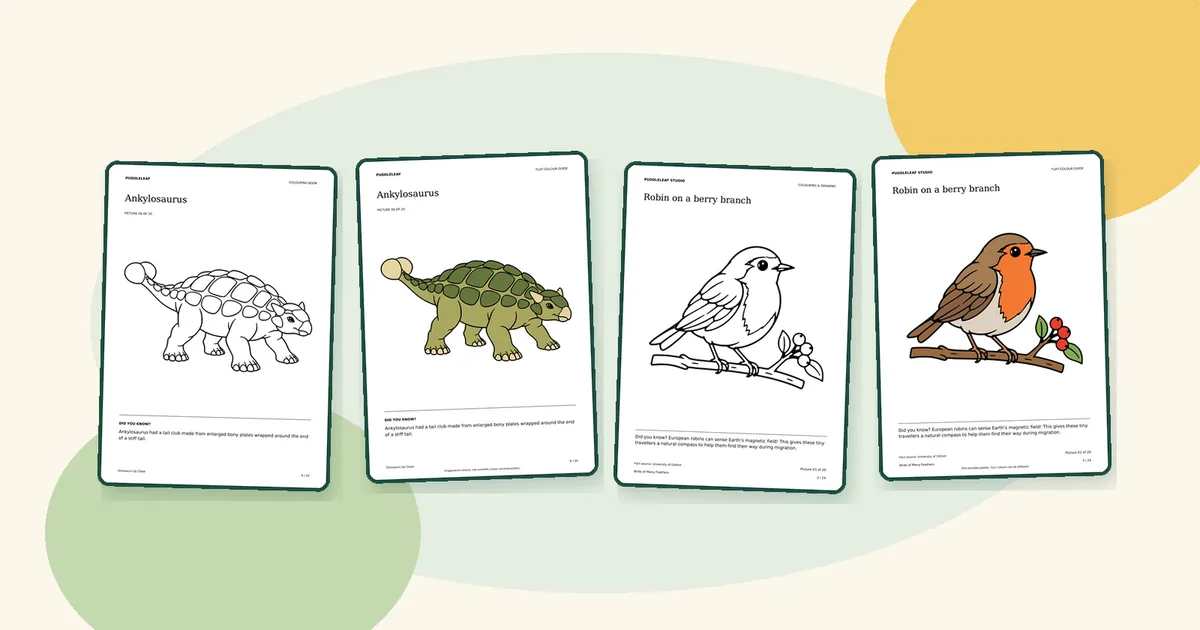
Every Puddleleaf colouring book comes with a matching colour guide: the same pictures, filled in with flat colours. Some children love it and follow it closely; others ignore it. Both are fine. This guide explains how to use colour guides well with children aged 4 to 8, so they help rather than get in the way.
What a colour guide is (and is not)
A colour guide is a finished example of the colouring page. It answers the question “what could this look like?” It is not an answer key. Real birds, cars and flowers come in many colours, and an imaginary purple giraffe is a perfectly good giraffe.
In our books, the guide is a separate file, so the colouring book itself stays clean. In the story books, open drawing spaces stay blank in the guide too, so a child’s own ideas never look “wrong” next to it. You can see examples on our colouring pages with a colour guide page, with free outline and guide pairs to print.
Four ways to use a guide
1. Follow it
Match each part of the picture to the guide, area by area. This suits children who enjoy order, like finishing things “properly”, or feel stuck in front of a blank page. Looking back and forth between two pictures is also a good exercise in looking closely.
2. Borrow one idea
Use the guide for one part only (the sky, the leaves, the body of a car) and choose everything else. This is a gentle middle ground for children who want some help but not a rule.
3. Make it different on purpose
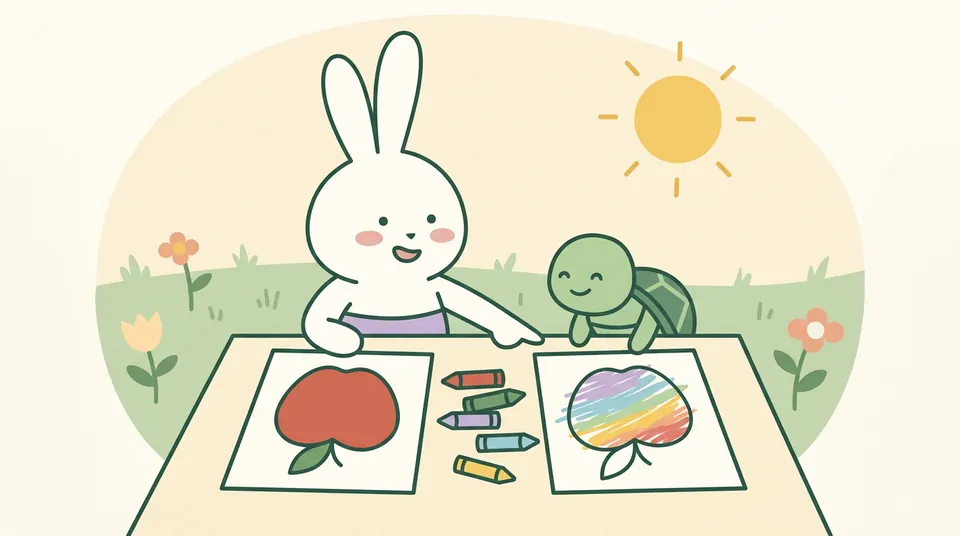
Look at the guide together, then challenge your child to make a version that looks completely different: a night-time scene instead of a day one, or a rainbow tugboat. Afterwards, put the two side by side and talk about what changed.
4. Reveal it at the end
Colour first without looking, then reveal the guide and compare. Children are often delighted when they chose the same colour as the guide, and just as pleased when they did not.
By age: what works
Ages 4–5
- Use the guide as a conversation. Point and name: “The guide made the rotor blades grey. What colour do you want yours?” This is easy practice in naming colours, which is one of the things the CDC lists for 4-year-olds (CDC, Milestones by 4 Years).
- Do not expect exact matching. Filling the general area in roughly the right colour is a good result.
- Keep the guide close. Place it right beside the page, at the same orientation, so looking back and forth is easy.
Ages 6–8
- Matching becomes a challenge. Many children this age enjoy matching a guide carefully, including small areas.
- Add shading. The guide uses flat colours; older children can add light and dark versions of the same colour for a 3D look.
- Talk about why. On fact pages, ask why the guide chose a colour: why is the lettuce several greens? Why do you think the guide chose that colour for the helicopter? It is a natural way into the facts on the page.
- Design a new palette. Ask them to make a guide of their own: colour the page, then use it as the guide for a sibling or friend.
Avoiding “wrong colour” pressure
A colour guide should take pressure off, not add it. A few habits help:
- Say “one possible way”, not “the right way”, when you introduce it.
- Never correct a child’s colour choice against the guide unless they ask you to.
- Make sure the guide is optional: some days a child will want it and some days not.
- Praise decisions (“you chose a dark sky, that looks like a storm”) more than accuracy.
Printing the guide, or not
You do not have to print the guide. Many families keep it open on a tablet or laptop beside the printed page, which saves colour ink. If you prefer paper, print only the guide pages for the pictures your child is colouring today. Our printing guide explains how to print a page range, and the best paper for colouring pages helps with paper choice.
Using guides in a classroom
- Print one guide per table rather than one per child, or show it on the board.
- Offer two options: “follow the guide” or “make your own version”. Children choose.
- For a quick display, pin finished pages next to the guide and invite the class to spot differences.
Before copying a paid book for a class, check its licence. Ours permit use in one educator’s own noncommercial classroom or small group.
Using a guide with on-screen colouring
If your child colours on a tablet using the free online colouring studio, a book’s companion file holds the outline pictures to colour on screen. The guide is a separate PDF, so open it on another device or print the page you need and keep it beside the screen.
Where to find books with guides
All of our colouring books include a guide. Good places to start: Aircraft Up Close and Flowers Up Close (their free samples include an outline page and its matching guide page), Know Your Salad for lots of greens, and the story books such as The One Red Crayon. Browse the vehicle, animal, nature and story collections.