
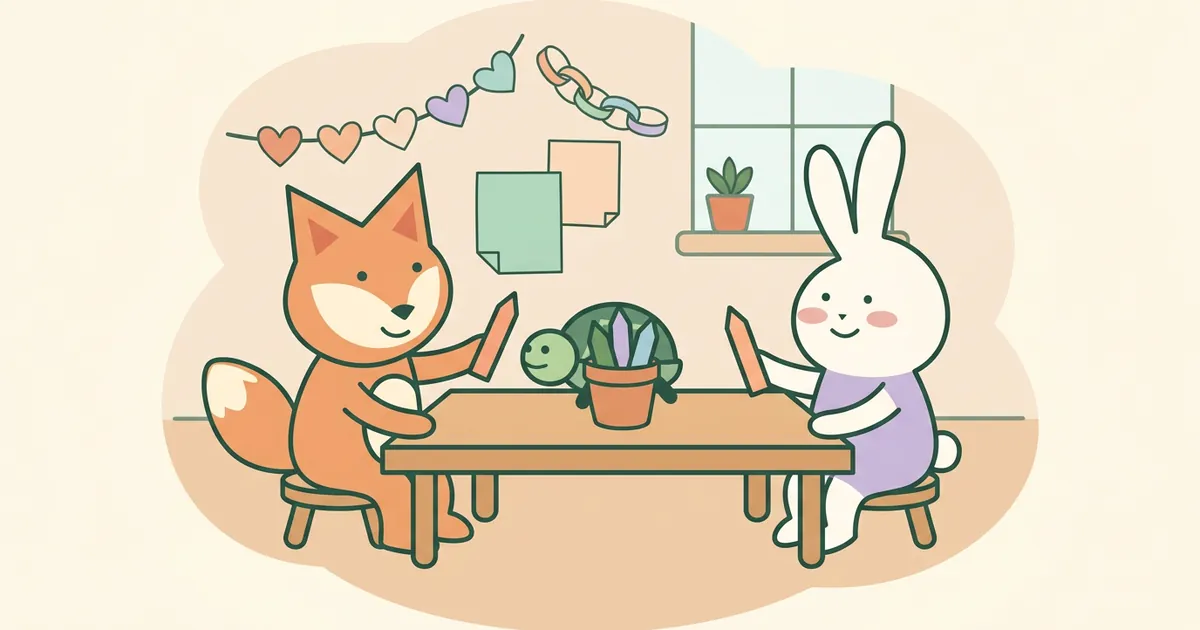
Kindness is easiest to teach when children can see it, talk about it and practise it in small, concrete ways. This guide collects classroom kindness activities for children aged 4 to 8 that need little preparation: most need a story, some paper and crayons. They work well across the year and especially for World Kindness Day, held every year on 13 November (Mental Health Commission WA).
Keep it optional. Kindness activities should never require a child to share personal stories, give away belongings, hug, or forgive on the spot. Inviting rather than requiring is part of the lesson.
1. Story circle with a colouring page
Read a short kindness story aloud while children colour a page from it. Colouring gives restless hands something to do and helps many children listen. Afterwards, ask one open question and accept any kind of answer: speaking, pointing at the picture or drawing.
Our free kindness colouring pages each include a story page and a drawing activity from a real story book, sorted by sharing, honesty, feelings and friendship. For tips on reading with a group, see reading a story colouring book aloud.
2. The one-crayon challenge (sharing)
Give pairs one special crayon (say, the only red) and one picture each that needs that colour. Before they start, the pair agrees a plan: taking turns by time, by area, or by one person finishing first. Halfway through, ask: is the plan still working? Would you change it?
This mirrors The One Red Crayon, where two friends with one red crayon try a plan and talk again when things change. The point is not perfect sharing, but noticing that a plan can be made, checked and changed together.
3. Kindness noticing wall
Put up a large sheet of paper titled “Kindness we noticed”. When a child notices someone else being kind (holding a door, helping tidy up, inviting someone to play), they draw it or tell you and you write it. The focus is on noticing others, not on earning praise for yourself.
4. Patchwork thank-you
Give each child a square of paper to decorate as a thank-you for someone who helped them: a classmate, a cleaner, a crossing supervisor. Join the squares into a patchwork on the wall. Children who prefer not to name someone can make a general “thank you to helpers” square.
The Patchwork Thank-You explores this same idea: gratitude can be small and thoughtful without becoming a duty or a forced gift.
5. Fixing a mistake together (honesty)
Role-play a small accident with puppets or two volunteers: a drawing gets torn, a tower gets knocked over. Ask the class what the person could say and do next. Collect ideas for honest words (“I did that, I’m sorry”) and repair (“can we fix it together?”).
The Kite We Fixed Together shows friends pausing, talking and mending a kite together after a mistake. The Words We Tried Again looks at a careful apology and makes clear the hurt person does not have to forgive straight away.
6. Many ways to say hello
Brainstorm greetings as a class: a wave, a nod, a smile, a word in another language, a thumbs up. Practise them in a circle, letting each child choose which greeting they are comfortable giving and receiving. Draw a “welcome sign” showing several choices for the classroom door.
This links to Two Ways to Say Hello, where a big wave and a small nod are both ways to say hello, without requiring touch or eye contact.
7. Make room for different needs
Ask children what helps them feel comfortable when the classroom is busy or noisy. Some like music; some like quiet. Together, design a “quiet corner” on paper or in the room. Kindness includes making room for people who like things differently from you.
See The Parade with a Quiet Corner for a story about more than one way to join in.
8. Listening bridge (cooperation)
In small groups, children build a bridge from blocks or paper that has to work for two different things (a toy car and a paper boat, for example). Each child explains what their part needs before anyone builds. Afterwards, talk about what listening changed.
The Bridge of Many Ideas uses the same idea with a tabletop village.
Planning for World Kindness Day
- Before the day: read one or two stories over the week before and start the noticing wall.
- On the day: story circle in the morning, the one-crayon challenge or patchwork thank-you after lunch.
- After: keep the noticing wall going. Kindness is a habit, not a one-day event.
A note on materials and licences
The free sample pages linked from our kindness page are there to try before buying. If you use a story book regularly with your class, each full book is licensed for one educator’s own noncommercial classroom or small group; please do not re-upload or share the files themselves. The full books contain 16 pages each, with a matching colour guide, in A4 and US Letter.
These activities and our books are creative resources, not a tested social-emotional learning curriculum. They can sit alongside your school’s own wellbeing program.