
Crayons, coloured pencils or markers? Each one feels different to use, suits different ages and pictures, and needs a slightly different paper. This guide compares the common options for children aged 4 to 8 and explains how to choose a small, sensible set rather than a drawer full of half-dried pens. (In Australia, felt-tip markers are often called textas; it is the same thing.)
The quick comparison
| Tool | Good for | Watch out for | Paper |
|---|---|---|---|
| Chunky wax crayons | Ages 4–5, big areas, pressing hard, rubbings | Hard to colour small details; can look patchy | 80 gsm copy paper is fine |
| Standard crayons | Ages 5–8, everyday colouring | Break easily; peel paper for side-shading | 80 gsm |
| Coloured pencils | Ages 5–8, detail, light-to-dark shading | Need sharpening; light colours can look faint | 80–100 gsm |
| Felt-tip markers / textas | Bold, bright colour quickly | Bleed-through, streaks, drying out if caps are left off | 120–160 gsm or light card, single-sided |
| Washable markers | Younger children, easier clean-up | Usually less vivid; still bleed on thin paper | 120 gsm or more |
| Oil pastels | Blending and big, rich colour | Smudgy and messy; hard on small details | Heavier paper or card |
For paper details and printer limits, see the best paper for colouring pages.
Crayons: the best first tool
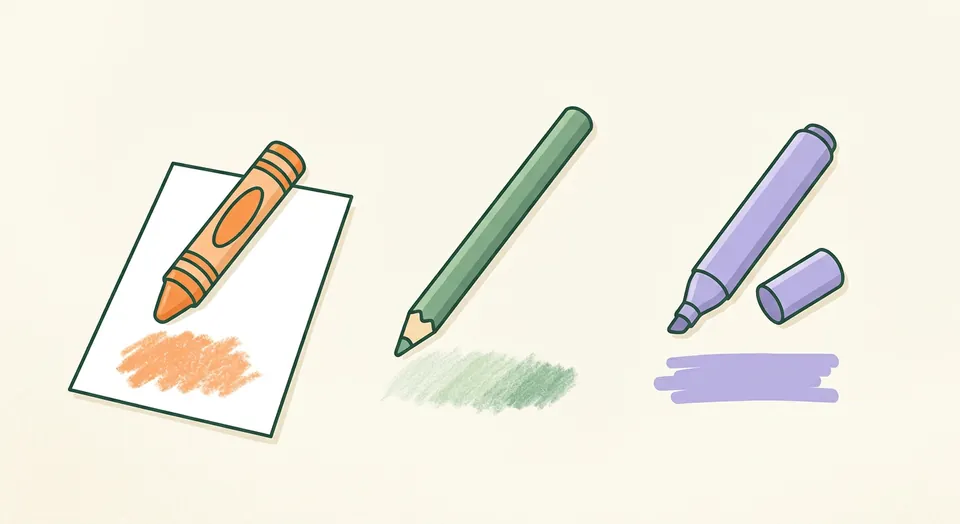
Wax crayons are forgiving. They work with a firm press, they do not need sharpening, and they cover big areas quickly. For younger children, short chunky crayons are easier to hold: Raising Children Network suggests offering chunky crayons and chalk until a child develops the finger-and-thumb grip needed for a pencil (Raising Children Network).
Two tips that make crayons look better: peel the paper off one crayon and use its side for big areas such as sky or grass, and go over an area twice in different directions to fill the gaps.
Best pages for crayons: pictures with large, simple shapes, such as the free Giraffe page from Zoo Wonders or the big landscape bands in Nature's Big Views.
Coloured pencils: for detail and shading
Coloured pencils give the most control. Children can press lightly for a pale colour and harder for a deep one, layer two colours, and get into small areas. They suit ages 5–8 and pictures with more detail, such as feathers in Birds of Many Feathers or the many parts of a vehicle in Cars and Road Vehicles.
Downsides: they need sharpening (a sharpener with a lid saves mess), leads break if dropped, and cheaper sets can look faint. A small set of good pencils is usually better than a huge set of weak ones.
Markers and textas: bold and fast
Markers give bright, even colour with almost no pressure, which some children love. They are great for bold pictures and for children who find pressing hard tiring. The trade-offs:
- Bleed-through. Ink soaks through thin paper. Print single-sided, use heavier paper if you can, and put a spare sheet underneath.
- Streaks. Colouring back and forth over a dry area leaves stripes. Small circles, or strokes in one direction, look smoother.
- Drying out. Caps left off are the number one marker killer. A cap-on-the-end habit helps.
Washable markers are easier on clothes and tables, and a sensible choice for younger children.
Choosing by age
Ages 4–5
Start with chunky crayons and a few washable markers. Keep the choice small (eight to twelve colours) so choosing is fun rather than overwhelming. Pages with big areas work best.
Ages 6–8
Add a set of coloured pencils for detail and shading, and regular markers for bold work. Children this age often like to choose the tool for the picture: pencils for a bird’s feathers, markers for a bright racing car.
Grip and comfort
The Royal Children’s Hospital Melbourne notes that most children naturally develop a pencil grip that is comfortable for them, and that a variety of grips are acceptable. It suggests offering a range of textas, coloured pencils, crayons and chalks so children are motivated to practise, and a comfortable seat with feet flat and forearms on the table (RCH, Developing a pencil grip). For more, see our guide to colouring and fine motor skills.
Safety basics
- Check the packaging for the age grading and safety information, and choose products intended for children.
- Supervise younger children, especially with small caps and broken crayon pieces.
- Keep markers away from mouths, faces and walls (you know why).
A small starter kit
- A box of chunky or standard crayons
- A set of 12–24 coloured pencils and a lidded sharpener
- A pack of washable markers
- A pencil case or tray so everything has a home
- Printer paper, plus a few sheets of heavier paper for marker pages
Colouring on screen
If you also use the free online colouring studio, you will notice its brushes are modelled on the same tools: a smooth marker, a textured crayon and a fine pencil. It is a fun way to compare how each one looks. See how to use the online colouring studio.
Test your tools on a free page first: our free colouring pages include A4 and US Letter PDFs from every collection.